
Nature & Ecotourism in Grand-Popo
Grand-Popo is a preserved natural sanctuary, nestled between the Mono River and the Atlantic Ocean. Mangroves, lagoons, endless beaches and biosphere reserves coexist within just a few kilometres. The nature ecotourism Grand-Popo experience rests on this unique diversity: in a single day, you can watch migratory birds at Bouche du Roy, paddle across the Mono through the mangroves, and end on a deserted beach as the sun sets over the ocean. It is this promise that draws more travellers each year in search of authenticity and preservation. For nature ecotourism enthusiasts, Grand-Popo checks every box: biodiversity, immersion, environmental respect and genuine encounters.
Grand-Popo, a natural paradise
Grand-Popo's coastline concentrates a diversity of ecosystems rarely found in such a small area. Within a few kilometres, you move from golden sand beaches to dense mangroves, calm lagoons to the lively ocean waters. This mosaic of landscapes shelters exceptional biodiversity.
Grand-Popo's geographical position, at the mouth of the Mono River which forms the border with Togo, creates a unique ecological gradient. Fresh river water, brackish lagoon water, salty ocean water: each zone has its specific fauna and flora. Scientists and naturalists come here to study the dynamics of West African coastal ecosystems.
This natural richness makes Grand-Popo a prime ecotourism destination. Unlike other beach resorts where nature gave way to concrete, Grand-Popo has preserved its landscapes. The accommodations themselves blend into the environment, often built with local materials without encroaching on fragile ecosystems.
For a full overview, the complete guide to Grand-Popo gives you all the keys.
Bouche du Roy
Bouche du Roy is Grand-Popo's ecological jewel. Here the Mono River meets the Atlantic Ocean in a delta of mangroves, sandbanks and lagoons. The site is classified as a biosphere reserve and listed on UNESCO's tentative World Heritage list.
The sight is striking: miles of virgin beach where the river pours into the ocean through a channel several hundred metres wide. Depending on the tide and season, the landscape transforms dramatically. At low tide, sandbanks emerge, forming islands accessible on foot. At high tide, the water rises and covers the beaches, leaving only the power of the current visible.
Bouche du Roy is a refuge for wildlife. Manatees, a threatened species, live in the calm delta waters. Migratory birds stop here by the thousands: flamingos, pelicans, herons, egrets, terns. Local fishermen know every channel, every sandbank, every current.
A pirogue (dugout canoe) excursion is the best way to discover this site. Allow two to three hours for a full exploration. Local guides know the best observation spots and will take you through the most secluded channels.
Our dedicated page tells you all about Bouche du Roy in Grand-Popo.
Mangroves and wetlands
Grand-Popo's mangroves are much more than an exotic landscape. They play a fundamental ecological role: coastal protection against erosion, fish nursery, habitat for birds and crustaceans, and a natural carbon sink. One hectare of mangrove stores up to five times more carbon than a tropical rainforest on land.
The Grand-Popo mangrove stretches along the Mono River and in the wetlands around the lagoon. Three species of mangroves dominate: Rhizophora racemosa, recognisable by its arched stilt roots that rise sometimes over two metres above the water; Avicennia germinans, with light green leaves and vertical aerial roots (pneumatophores) that poke out of the mud like fingers; and Laguncularia racemosa, rarer, growing on sandier soils. Each species occupies a precise zone depending on water salinity and immersion duration.
The stilt roots create a vegetal labyrinth where light barely filters through. The air is charged with humidity and strong odours: iodine, mud, salt, wet wood. At low tide, fiddler crabs emerge from their burrows, waving their single claw to attract females. Mudskippers, amphibious fish that move across the mud by hopping, watch visitors with their protruding eyes.
Exploring the mangrove by pirogue is an immersive experience. The silence is broken only by the lapping of water, bird calls and the brushing of branches against the canoe. Local fishermen know these channels better than anyone: they have harvested shrimp, crabs and fish here for generations. A guided outing lasts between 90 minutes and two hours and costs 8,000 to 15,000 FCFA (12 to 23 EUR) per person.
The threats to the mangroves are real: urbanisation, pollution, climate change. Several local initiatives work on their preservation. The association Les Gardiens de la Cote organises mangrove replanting campaigns that visitors can join. By visiting the mangrove with a local guide, you directly support these efforts.
For more detail, see our Grand-Popo mangroves guide.
A mangrove visit is also an opportunity to observe shrimp collectors at work. Armed with large conical wicker baskets, they move slowly through shallow waters at low tide, plunging their baskets into the mud to catch the grey shrimp hiding there. This traditional fishing, done mainly by women, provides an essential ingredient for the local cuisine. Gba na, a dried shrimp sauce with tomato and chilli, is one of Grand-Popo's most popular dishes. If you come across these collectors around a channel, a simple wave is enough to exchange smiles before leaving them to continue their quiet work.
The Mono River
The Mono rises in Burkina Faso, crosses Togo, and after 500 kilometres, empties into the Atlantic at Grand-Popo. It is the region's lifeline: freshwater source, transport route, fish reservoir and home to thousands of families.
Pirogue excursions on the Mono are among the most popular activities in Grand-Popo. You will encounter fishermen casting their nets, women doing laundry on the banks, children diving from canoes. The river's life is a constant spectacle.
The Mono's banks offer varied landscapes: dense mangrove here, a sandy beach where canoes are pulled ashore there, further on a fishing village with colourful houses. The sunsets on the river are among the most beautiful in Benin, the sky taking on orange and purple hues reflected on the water.
The Mono also marks the natural border between Benin and Togo. A pirogue trip to the boundary of the two countries is a unique way to discover the region from the water.
Our Mono River guide gives you all the tips for organising your outing.
Sea turtles
Between September and March, Grand-Popo's beaches become a nesting site for several threatened sea turtle species. Green turtles, hawksbill turtles and olive ridley turtles come to lay their eggs, digging their nests in the warm sand under cover of night.
Watching a sea turtle lay eggs is a rare and moving moment. These ancient animals, travelling thousands of kilometres in the ocean, return to nest on the same beach where they were born. The slowness of their movements, the concentration and vulnerability of the moment create a unique connection with nature.
Local conservation programmes protect nesting sites and raise community awareness. Several associations organise supervised night outings to observe the turtles without disturbing them. It is essential to follow the rules: no white light, no flash, no noise, keep your distance.
To find out when and where to watch the turtles, read our sea turtles guide.
Birdwatching
Grand-Popo is a paradise for birdwatchers. Over 200 bird species have been recorded in the area, from resident species to Palearctic migrants that cross the Sahel each winter.
Bouche du Roy is the best observation spot, especially early morning or late afternoon. Flamingos, emblematic of the region, are present for much of the year. You can also spot white pelicans, little egrets, grey herons, ospreys, little terns and dozens of other species.
The mangroves and Mono River banks are also rich areas. Kingfishers, weavers, sunbirds and rollers add touches of colour to the landscape. For serious birders, Grand-Popo is an essential stop on the West African bird route.
Bring your binoculars and field guide. The dry season (November to March) is the best period, coinciding with the presence of European migrants.
Check our birdwatching guide for the species list and best spots.
Butterfly watching
Grand-Popo's wetlands and coastal forests host a remarkable diversity of butterflies. Over eighty species have been recorded, some endemic to the West African coast. Butterflies are most active in the dry season, from November to March, when the sun warms the undergrowth without drowning it in rain.
The Papilio demodocus, or large citrus swallowtail, is the most common. Its black wings decorated with yellow and blue spots cut a powerful, irregular flight. The Charaxes, more discreet, often lands on tree trunks where it blends with the bark. African morphos, with metallic blue wings, cross clearings in a flash of light.
The best spots are the edges of mangroves, the gardens of Villa Karo (where exotic vegetation attracts many species) and the paths along the lagoon. Bring a camera with a macro lens and a field guide: every walk holds discoveries. Some accommodations offer guided butterfly-watching outings with a local naturalist.
The salt marshes
Grand-Popo's salt marshes are a living testament to the ancestral knowledge of Xwla women. Here, salt is not imported or industrially produced: it is harvested by hand in the salt pans bordering the lagoon, using techniques passed down through generations.
The process is simple in appearance but requires precise knowledge of water and sun cycles. Seawater is channelled into shallow basins through a system of canals and wooden sluices. Under the tropical sun, the water evaporates slowly, leaving behind an increasingly concentrated brine. After several days, when the concentration reaches the right level, the first crystals appear on the surface. The women scrape them with long wooden rakes, wash them in clear water basins and leave them to dry in the sun on straw mats.
The salt pans stretch over several hectares near the lagoon. At certain hours, when the sun is at its zenith, the basins sparkle with a thousand lights, creating an almost surreal landscape. The air is charged with iodine and salt, and the silence is broken only by the rustle of wind in the palms and the scraping of tools on the salty ground.
Visiting the salt pans means meeting these women who perpetuate a millenary tradition. They begin their work at dawn, before the heat becomes crushing. Their gestures are precise and economical: every movement is the fruit of decades of practice. The artisanal salt of Grand-Popo, coarse-grained and more flavourful than industrial salt, is renowned throughout Benin. It is sold at local markets for 500 to 1,000 FCFA per kilo (0.76 to 1.50 EUR). You can buy it directly on site, an authentic souvenir that supports the local economy and preserves a vanishing know-how.
Our page on Grand-Popo's salt marshes explains how to organise a visit.
The beaches
Grand-Popo's beaches rank among the most beautiful in Benin. Fifteen kilometres of golden sand lined with coconut palms, with a frequently rough sea that puts on a permanent show. Unlike the developed beaches of large resorts, here nature dominates.
Swimming is possible but requires caution. Atlantic currents can be powerful. Ask your accommodation about safe areas. The beaches in front of the ecolodges are generally monitored and calmer.
Walking on the beach at Grand-Popo is a total sensory experience. The powerful sound of the waves, the smell of iodine and warm sand, the feel of the wind on your skin, the infinite horizon opening before you. It is also a chance to cross paths with fishermen hauling their canoes, women collecting driftwood, children playing in the waves.
Discover our Grand-Popo beaches guide for swimming recommendations.
Land wildlife and flora
Beyond the coastline and wetlands, Grand-Popo's hinterland hosts varied land wildlife and flora. Oil palm forests, coconut plantations and coastal savannahs are home to terrestrial birds, small mammals and reptiles.
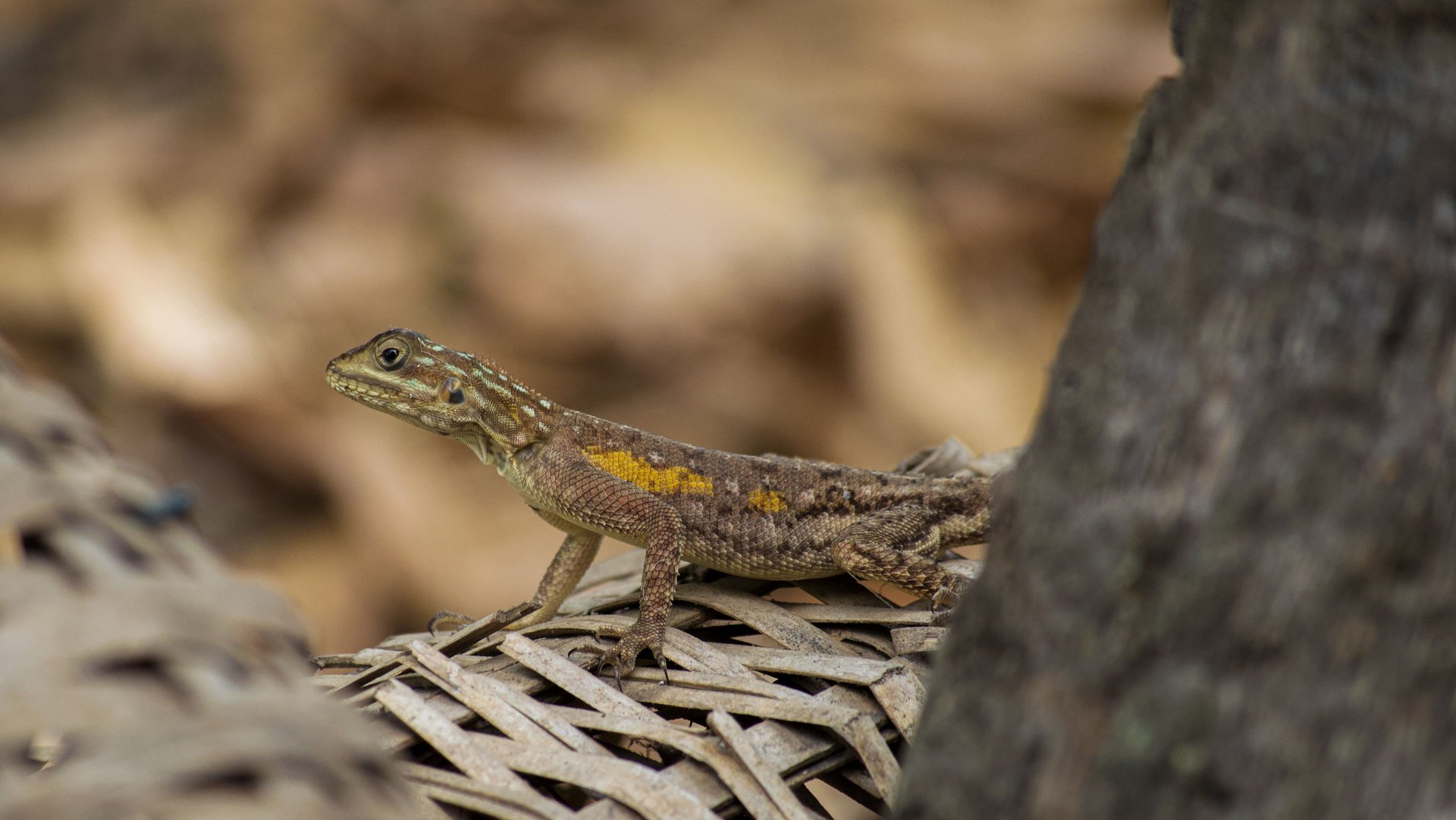
Vervet monkeys are frequently seen in trees around dwellings. Nile monitors bask in the sun on the riverbanks. Chameleons, discreet and captivating, change colour before your eyes.
On the flora side, coconut palms reign over the landscape, but you also find kapok trees with impressive buttress roots, oil palms, mango trees, banana trees and many medicinal plant species used in the local pharmacopoeia.
Our wildlife guide tells you more about species to observe.
Responsible ecotourism
Visiting Grand-Popo means stepping into a fragile ecosystem. Every action counts to preserve what makes this place beautiful. Here are some simple principles:
Leave no trace. Take your waste with you, take nothing (shells, plants) and stay on marked paths.
Support the local economy. Prioritise local guides, locally-run accommodation and handmade products. This is the best way to ensure your visit benefits the community.
Respect wildlife. Do not approach animals, do not touch turtles, do not feed monkeys. Silent, respectful observation is the only appropriate attitude.
Reduce your impact. Limit your water consumption, avoid single-use plastics, and choose eco-responsible accommodation.
Ready to explore Grand-Popo's nature?
Grand-Popo's nature is generous, but also vulnerable. Visiting it with respect ensures it will remain as beautiful for future generations. Whether you come for Bouche du Roy, the sea turtles or simply to walk on a deserted beach, you will leave with lasting memories and the desire to return.
To organise your stay and book nature excursions, contact us on WhatsApp. Our local guides are passionate people who know every corner of this unique ecosystem.
Plan Your Visit
Discover the magic of Grand-Popo with our curated local experiences.