
Colonial Architecture of Grand-Popo: History and Heritage
The alleys of Grand-Popo carry the silent traces of several centuries of colonial history. Before becoming a sought-after beach resort, the town was a strategic trading post for European merchants, then an administrative capital under French colonization. Today, this colonial architecture Grand-Popo can be read in the ochre walls of former factories, the wrought-iron balconies of Sobrado houses and the facades of early 20th-century public buildings. This fragile heritage, threatened by coastal erosion and time, deserves to be discovered and preserved. For the broader cultural context, see our culture and heritage guide.
Grand-Popo, former colonial capital
Few travelers know that Grand-Popo was, between 1883 and 1889, the capital of the French trading post of the same name, before the administration was transferred to Porto-Novo. This status led to the construction of official buildings, administrators' residences and port infrastructure, of which vestiges remain.
The town was already a commercial crossroads long before the Europeans arrived. The Xwla, a lagoon people, controlled the salt and dried fish trade between the coast and the interior. The Europeans, arriving from the 17th century onward, set up trading posts for palm oil, ivory and, tragically, the slave trade.
European trading posts
Portuguese trading post (17th-18th century). The Portuguese were the first Europeans to establish themselves permanently on the coast. Their post, located near the mouth of the Mono, served as a relay between Sao Tome, Brazil and the Gulf of Benin. Laterite stone foundations are still visible in the gardens of some private seafront properties.
French trading post (18th-19th century). The French established their factory at the site of the present-day Avlo market. This long building, with its veranda running the full facade and wooden shutters, is a typical example of West African colonial architecture. Now converted into an administrative building, it retains its original structure.
Danish trading post (17th century). Less well known, the Danish trading post was located west of the town, near the present-day Togolese border. Only a few eroded stones remain, but Danish archives preserve detailed plans of this trading post, active from 1661 to 1750.
Major buildings
Villa Karo. Built in 1898 as the residence of the French district commander, Villa Karo is the finest example of preserved colonial architecture in Grand-Popo. Its thick banco walls, canal-tile roof and veranda ringed with small columns make it a remarkable edifice. Converted into a Finnish artists' residence in the 2000s, it now hosts exhibitions and cultural events.
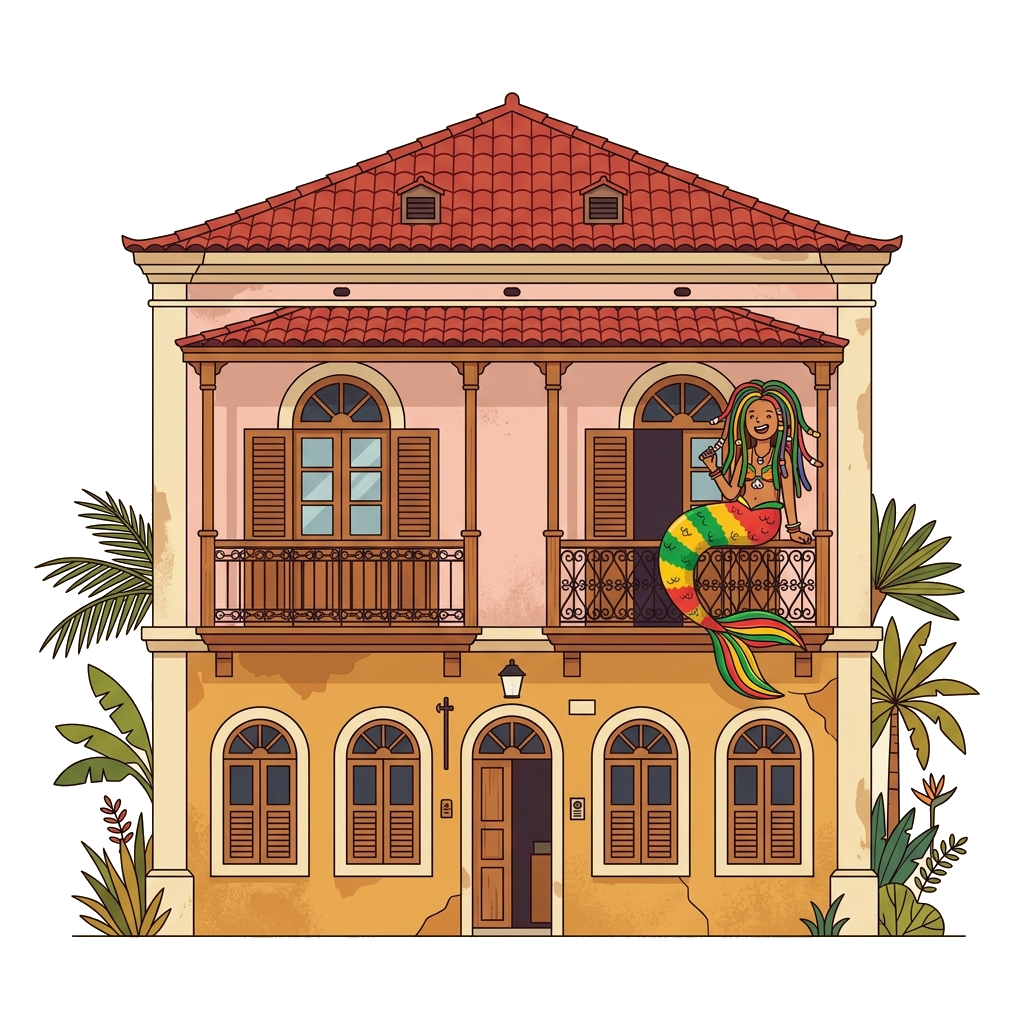
The Afro-Brazilian Sobrado. Hidden in the Gbakpodji quarter, a 19th-century Sobrado testifies to the return of former slaves from Brazil. This two-story building, constructed using Afro-Brazilian techniques, combines local stone walls with a South American ipé wood frame. The ornate wrought-iron balconies, colorful shutters and wide verandas are the hallmarks of this architectural style, unique in West Africa. A visit here is a plunge into the history of the Agoudas, the returning slaves who profoundly marked the architecture and culture of the region. On the ground floor, the former palm oil shop has been converted into a small exhibition space.
The former colonial courthouse. Near Avlo town hall, a public building from 1912 still bears the arms of the French Republic on its pediment. Now disused, it remains an imposing witness to colonial administration and its utilitarian yet careful architecture.
Erosion threatens the heritage
The colonial architecture Grand-Popo faces a growing threat: coastal erosion. The retreat of the coastline, estimated at 5 to 10 meters per year in some places, has already swallowed several historic seafront buildings. Increasingly frequent storms accelerate this phenomenon. The remains of the Portuguese trading post and several Sobrado houses are directly threatened.
Residents report that entire streets have disappeared in one generation. Colonial buildings visible in the 1980s are now underwater. This situation, common to the entire Beninese coast, makes documenting and preserving what remains an urgent task.
Conservation and restoration
Several conservation initiatives are underway. Villa Karo, maintained by Finnish cooperation, serves as a model for respectful restoration of colonial heritage. Local artisans are trained there in traditional banco masonry and carpentry techniques.
The Association of Cultural Guides of Grand-Popo is working to inventory historic buildings and offers tours whose proceeds go toward their maintenance. Taking these tours is a concrete gesture for heritage preservation.
The Beninese government, aware of the importance of this heritage for cultural tourism, has listed several sites on the indicative list of national heritage. A coastal conservation plan is being developed with UNESCO support.
Walking tour
To explore Grand-Popo's colonial architecture, a 2 to 3-hour walking tour is recommended, preferably in the morning (7 am to 10 am) to avoid the heat. Start at Avlo market, then head to Villa Karo (15 minutes on foot). Next, take Rue des Agoudas toward Gbakpodji to discover the Sobrado. Return along the coast to see the Portuguese remains before finishing at the former courthouse.
A local guide will provide anecdotes and historical details that plaques do not tell. Some guides are direct descendants of Agouda families and share orally transmitted family memories, making the visit deeply personal. Expect about 10,000 FCFA (EUR 15) for a 3-hour guided tour. Wear closed shoes and bring water: walking under the tropical sun is demanding.
Take as many photos as you like, but always with discretion in front of private homes. Every facade tells a chapter of this crossroads city's history between Africa, Europe and the Americas. Take time to stop before each building, observe the architectural details and imagine the life that unfolded there a century ago.
Plan Your Visit
Discover the magic of Grand-Popo with our curated local experiences.